Verified WaBanja Couple
Yuna Seo & Minjun Kwon
The City Became Ours in Small Pieces
Location
 Seoul, South Korea
When They Met
Matched on WaBanja
Milestone
Dating
Reading Time
~7 min read
“I knew how to get to work, the supermarket and the nearest place that sold decent noodles. For the first few months, I called that knowing the city.”
I knew how to get to work, the supermarket and the nearest place that sold decent noodles. For the first few months, I called that knowing the city. It was only when a colleague asked where I liked to spend a Sunday that I realised I had an answer for errands and no answer for enjoyment.
Moving had been my choice. I had a job I wanted, a room with reasonable light and enough money to manage if I was careful. I was also tired of eating dinner while listening to people I knew through a speaker on my laptop. I did not want somebody to rescue me from that. I did want to meet someone whose company existed in the same place as I did.
I joined WaBanja on an evening when I had already changed into the clothes I slept in. I mention this because, in my memory, important decisions should happen when I look more prepared for them. In reality, I was waiting for washing to finish. I wrote a profile that said I was still learning the city and would welcome a recommendation that was not another supermarket.
Yuna asked whether I had tried the public library. I said I was looking for somewhere to spend time, not somewhere to do homework. She replied that this suggested I had not visited a good library lately. There was something wonderfully unromantic about the exchange. I did not have to decide what kind of person I was going to sound like. I only had to answer the question she had actually asked.
We continued talking. Yuna had been in the city longer than I had, but she did not behave as though she had solved it. She knew a few places well and admitted that there were whole parts she had never visited. I liked that. When you are new somewhere, advice can sometimes arrive as an inventory of all the things you have failed to experience. Hers sounded more like an invitation.
Our first meeting began outside the library on a Saturday afternoon. We had arranged to look at a small public display and then decide whether we wanted to get something to eat. I arrived early enough to walk past the entrance twice. When she arrived, she asked whether I had been waiting long. I said no. It was the smallest possible lie, and she must have recognised it because she smiled without making me explain.
We spent more time looking at the shelves than the display. She showed me a corner where the light was good. I found a book of photographs of the city from years before either of us lived there. We recognised almost nothing, which was oddly comforting. We were not failing to know a finished place. We were getting to know somewhere that had always been changing.
Afterwards, we ate at a busy place around the corner. I had expected a first meeting to require an uninterrupted supply of interesting questions. Yuna seemed perfectly willing to discuss the food, the weather and the trouble she had finding a lamp that was neither ugly nor unexpectedly expensive. I told her about the chair in my room that made a noise whenever I moved. She said that sounded like a flatmate who did not pay rent.
I went home pleased and then immediately tried to decide how soon I could ask to see her again without sounding too pleased. That is one part of dating I would happily remove if anybody put me in charge. I sent a message that evening saying I had enjoyed myself. She answered that she had too and suggested another walk. Apparently, the complicated strategy had not been necessary.
Over the next few weeks, the city acquired small points of familiarity. There was a bench where we had argued cheerfully about the ending of a film. A bakery where she always said she would only buy one thing and then remembered somebody else who might like something. A bus stop where we once waited on the wrong side of the road while confidently discussing how much better I was becoming at finding my way around.
It would be easy to describe that as the time everything became better. Some things did. Other things became more complicated because I was now interested in somebody whose life did not revolve around my need for company. Yuna had friends, work and evenings she wanted to spend alone. I understood that in theory. In practice, I occasionally heard “I have plans” as “I would rather not see you.”
She noticed before I admitted it. One evening, after I had sent a disappointed answer to a perfectly ordinary change of plan, she asked whether I was angry with her. I said no, then said I was having a lonely week. Those were not the same thing, and naming the difference helped. She told me she wanted to see me, but she could not be the only thing I looked forward to in a city that was supposed to become my home.
I did not enjoy hearing it. I also knew she was right. I began saying yes when colleagues suggested something after work. I found a weekend group connected to an interest I had neglected. Sometimes I went back to the library alone. None of this made me less interested in Yuna. It made the time with her feel less like something I had to hold very tightly in case it disappeared.
The group met on Sunday mornings to sketch parts of the city. I had drawn very little since leaving school and almost did not go. At the first meeting, I spent twenty minutes attempting a bridge that seemed to acquire a new angle every time I looked up. The person beside me said mine looked as though it was escaping. I told her that was a generous interpretation. We compared drawings and agreed that neither of us should be consulted about structural repairs.
When Yuna asked how it had gone, I told her about the conversation before mentioning the drawing. She said that sounded like a good morning. I noticed I had not spent those hours checking whether she had messaged. The next Sunday, I went back because I wanted to see whether I could draw the bridge any better and because I was curious about the people I had met. That felt like a small piece of progress I could claim for myself.
She had changes to make too. She could become brisk when she was busy and assume that everyone understood what she meant. I told her that a short explanation helped me more than reassurance offered after I had already guessed the wrong thing. She listened. We were learning that independence and consideration were not opposites, though both of us occasionally behaved as though they were.
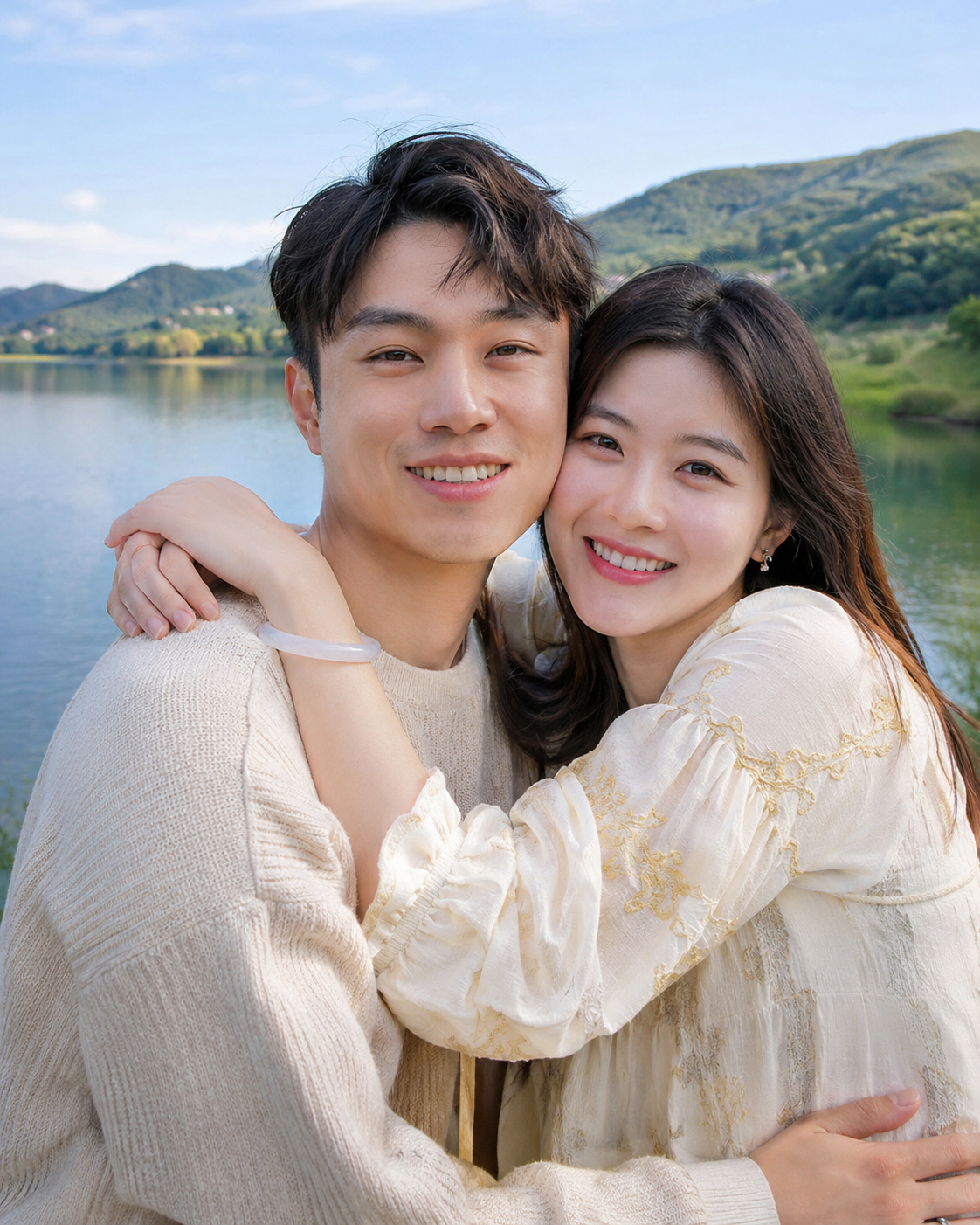
The lake trip was not our first escape from the city, but it was the first one we organised without turning it into a small administrative crisis. We checked the journey, packed food and agreed that neither had to enjoy every minute of the walk. The photograph was taken near the water, close enough that there was barely room for the hills behind us. Yuna put her arm around my shoulders and told me to stop watching the camera as though it might ask a difficult question.
I like that photograph. I also like the less attractive places that do not appear in it: the library entrance where she first waited for me, the pavement beside the bus stop, the ordinary shop where I bought the lamp she eventually found. The city became ours in small pieces, but it also became mine. That has made loving her feel more like a choice I keep making and less like a solution I am afraid to lose.